
Engineering Guide
How Much Weight Can a Wooden Pallet Hold?
Wooden pallet load capacity depends on three different load types — static, dynamic and racking — and six specification choices at manufacture. Here is how CeyPall engineers pallets to a stated load.
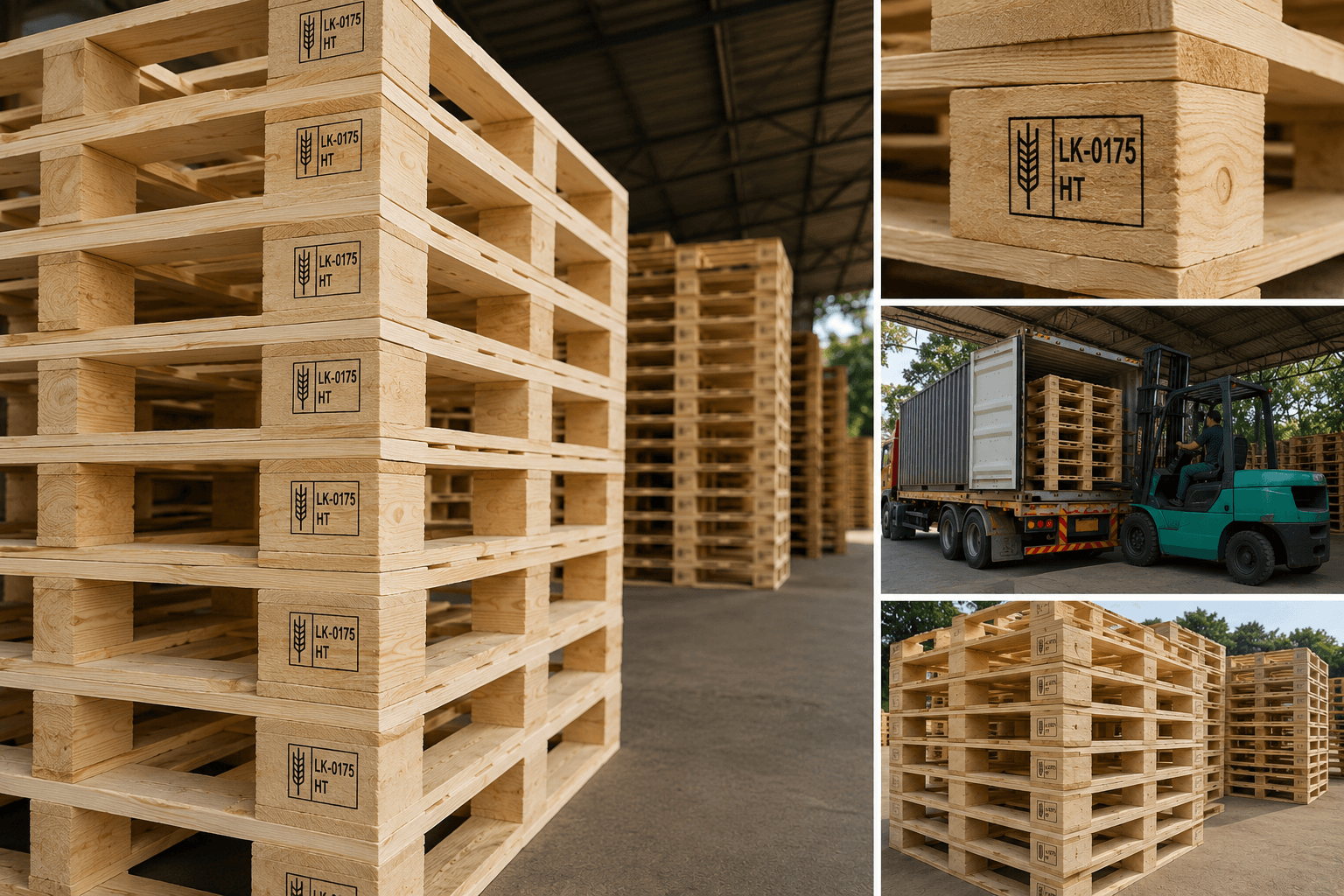
In short: how much weight can a wooden pallet hold?
A standard wooden pallet holds 1,000–1,500 kg static load. Heavy-duty builds carry 2,000 kg or more. Dynamic (handling) load is typically 40–60% of static, and racking load is lower again — always specify the rating that matches how the pallet will actually be used.
Three load types
Static vs Dynamic vs Racking
A pallet has three different capacity numbers. Choosing the right one for your application prevents mid-shipment failures.
Static load
Weight the pallet holds sitting on a flat floor. Highest of the three ratings — the deck is fully supported. Example: a heavy-duty pallet may hold 2,000 kg static.
Dynamic load
Weight the pallet can safely carry while being moved by a forklift or pallet jack. Typically 40–60% of static load. This is the rating that matters for actual handling.
Racking load
Weight the pallet can bear when supported only at its edges on rack beams. Usually the lowest rating because the pallet spans an unsupported gap and deflects under weight.
What sets the rating
Six Specification Factors
Timber species
Denser hardwoods carry more load per unit thickness than softer species. Grade (knots, splits, grain) also affects strength.
Board thickness
A 22–25 mm deck board resists bending far more than a 15–18 mm board — thickness scales stiffness non-linearly.
Stringer / block size
Wider or taller stringers control how load transfers to the floor and reduce mid-span sag under weight.
Deck spacing
Tighter top-deck spacing distributes point loads across more boards, protecting fragile or narrow-footprint cargo.
Entry type
Two-way pallets with continuous stringers are typically stiffer under heavy static loads; four-way gives handling flexibility.
Bottom deck
A full or reinforced bottom deck resists diagonal deflection and is essential for racking and stacked storage.
Failure modes
How Overloaded Pallets Fail
Understanding failure modes is the fastest way to specify the right pallet the first time.
Deck-board fracture
Board bends beyond its elastic limit under a point load — usually from an under-specified board thickness for the cargo.
Stringer crack
Stringer splits along the grain, often at a nail or notch, under repeated dynamic loads or racking deflection.
Nail pull-out
Cyclic handling loosens nails, boards separate, and the load shifts. Prevented by correct nail pattern and timber density.
Racking deflection
Pallet sags in mid-span on the rack beam, dropping cargo or fouling the rack below. Caused by racking-rated load being exceeded, or by wet timber.
Common questions
Load Capacity FAQs
How much weight can a wooden pallet hold?
A standard wooden pallet typically carries 1,000–1,500 kg static load. Heavy-duty pallets can be built to bear 2,000 kg or more. The exact rating depends on timber species, board thickness, stringer configuration, deck spacing and whether the pallet will be lifted, stacked or racked.
What is the difference between static, dynamic and racking load?
Static load is the weight a pallet can hold sitting on a flat floor. Dynamic load is the weight it can safely carry while being lifted or moved by a forklift or pallet jack — typically lower than static load. Racking load is the weight the pallet can bear when supported only at its edges on rack beams, and it is usually the lowest of the three because the pallet spans an unsupported gap.
What determines pallet load capacity?
Timber species and grade, board thickness, stringer or block dimensions, deck spacing, entry type and bottom-deck configuration all determine load capacity. Denser timber and thicker boards carry more load; tighter deck spacing distributes point loads; reinforced stringers control deflection under weight.
Does moisture content affect pallet load capacity?
Yes. Wet or high-moisture timber loses stiffness, and the pallet will deflect and fail at loads it would otherwise bear. Heat-treated pallets are dried during processing; long-term outdoor exposure can raise moisture again. For accurate specification, timber should be at production-standard moisture content when the pallet is loaded.
How do I specify load capacity when ordering?
Tell CeyPall four things: the maximum weight the pallet will carry, whether it will be lifted or moved (dynamic), whether it will be racked, and how the load is distributed (evenly across the deck or on a narrow footprint). We will specify the timber, board thickness and stringer configuration to meet the requirement.
Keep exploring
Related pages
Need a Load-Rated Pallet?
Tell us your load, footprint and handling. We will engineer and quote the right specification.